
Registered Equine Massage Therapy
Initial Consultation $140 +tax
Follow up Appt $110-120 +tax
*See cancellation/no show policy
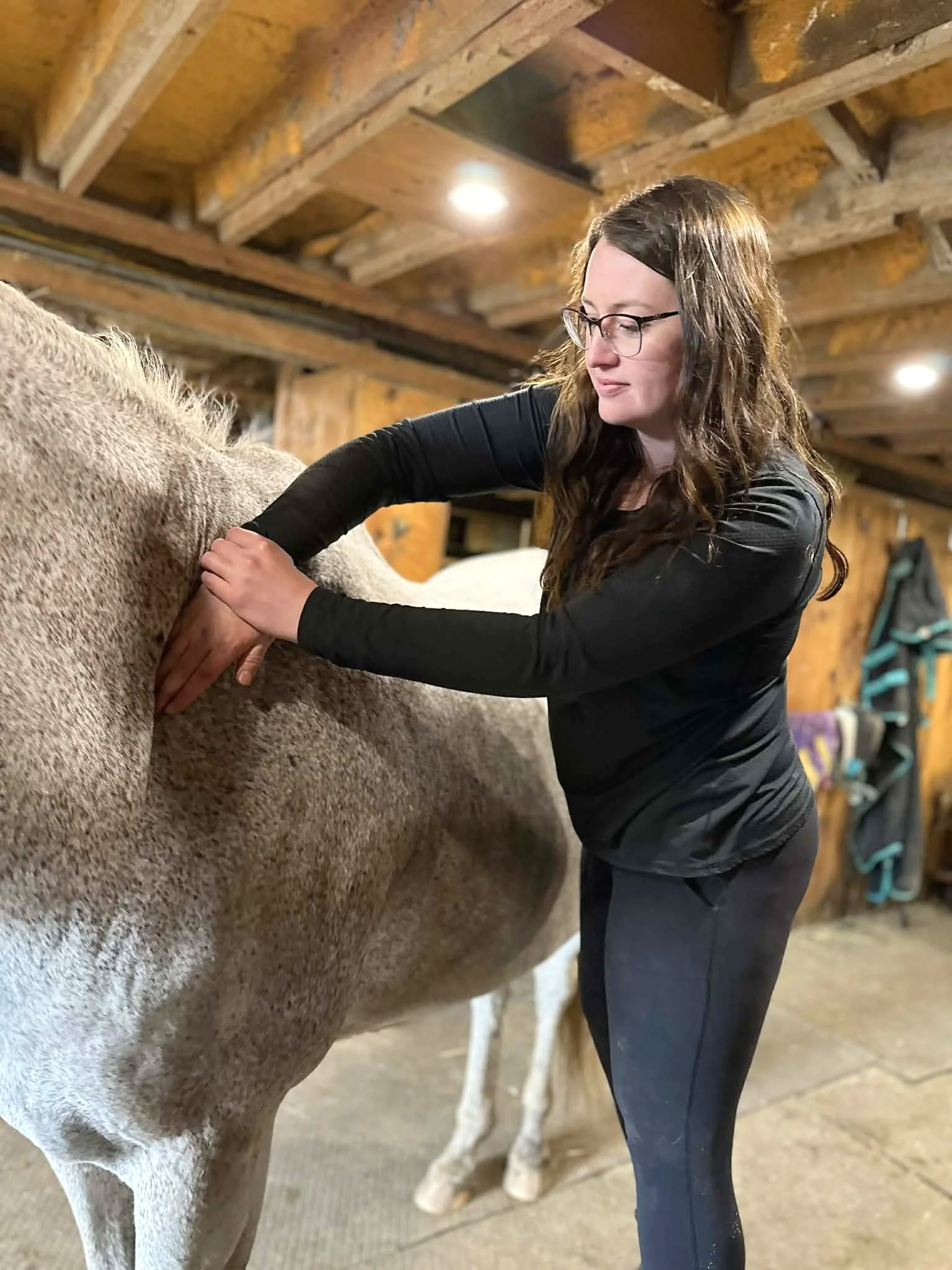
Massage therapy has been used for thousands of years amongst humans to enhance the natural healing mechanisms of the body by relieving pain, speeding healing, promoting balance, and maintaining internal and external health. It has evolved into an integral component of health care in sports medicine, athletic development, injury rehabilitation, and day-to-day improvement in overall wellbeing. It is only in more recent years in which Western Medicine has followed suit with eastern cultures, and begun to apply this knowledge, research, and practice into animals as well as people.
We can all agree that horses are athletes; and just as a human athlete has a team of bodywork and health care providers who work together to maintain that athletes peak athletic potential and prevent injury, as should our horses. Unfortunately, our animals can only communicate in ways that we sometimes do not innately understand. Sometimes this appears as a decrease in stamina, reluctance to perform something that once was easy, difficulty learning a new concept, “naughtiness”, or general unhappiness. It is our job as owners/riders/trainers/coaches to continuously seek the assistance of our horse’s team of professionals to help break down the communication barriers and provide everything we can to help our four-legged friends and teammates to perform and function at their optimal comfort level. And it is our job as therapists, chiropractors, farriers, veterinarians to forge strong communication with each other to work together for the love of the horses.
How do I know if my horse needs massage therapy?
There are many indications that your horse may be suffering from restriction, discomfort, and pain, ranging from very subtle signs that you may have brushed off as the horse’s normal personality, or to severe symptoms such as bucking, kicking, spooking, and rearing. Don’t wait until a serious injury or behavioral issue develops.
If your horse exhibits any one or more of the following, it may be time to contact a qualified professional.
Pinning ears
Tail swishing
Girthing sensitivity
Difficulty engaging the hind end
Preference with its canter leads
Bucking, rearing, spooking
Crookedness
Teeth grinding
Tension through jaw and poll
Difficulty backing up
Short striding
Asymmetrical hoof growth
Refusal to jump
Head tossing
Difficulty with lateral bending
Tracking unevenly
Unidentifiably “off” but not necessarily “lame”
Uneven sweat marks
Behaving “bad” or “naughty”
A qualified therapist will not only identify the areas of concern, but will help you isolate and address the cause, as well as provide you with a guideline and treatment plan detailed to your horses specific needs. These suggestions may include stretching and exercises, nutritional concerns, any tack changes or alterations, or referral to farrier, chiropractor, or veterinary assessment.
Benefits of Massage Therapy
Prevention of injury by increasing pliability, mobility, and flexibility of soft tissues.
Reduction of recovery time after injury by prevention of adhesion formation, decreasing muscle spasm, relieving pain, maintaining muscle tone and strength, and reducing inflammation and swelling, and promoting healthy and proper tissue healing.
Enhancing your horse’s athletic performance by balancing tone, decreasing trigger points, and increasing strength and range of motion.
Relaxation or stimulation of the nervous system and muscles.
Promotion of the elimination of toxins and metabolic waste.
Conditions that Benefit From Rehabilitative Massage Therapy (just to name a few):
Tendon injuries (DDF, SDF, Suspensory, etc)
Strain/Sprain
Bursitis
Arthritis
A headache
TMJ Disorders
Torticollis
Nerve damage/paralysis
Lumbar Myositis
Cold Back
Kissing Spines
Splints
Tenosynovitis
Ring Bone
Upward Patellar Fixation
OCD
Meniscal Tears
Subluxation of Pelvis, SI, Spinal Vertebrae, TMJ etc
Laminitis
Navicular
Lymphangitis